Friday, 11 September 2015

Blog update

Times they are a'changin. For a long time now, I've been spending more time developing writing workshops and widening my interests and as a result, the poor old Oncoplastic Fruit blog has been left in limbo. I'm still working on the breast cancer book - it is my life's work - but I think it's right that I bring this blog to a close. See you again one day.

Cheers! xxx


Friday, 26 September 2014

Away with the Fairies...

More than a year has passed since my last post. I can't quite believe it. It feels like I have been time travelling. A lot has happened in the last twelve months. Our family swapped Cornwall's seagulls for Australian cockatoos and kookaburras as we spent several months living and working in Canberra. Before that, I was on a six-month course exploring a business idea around workshops in writing for health. I'd also been volunteering with dementia patients and breast cancer survivors and trying to understand the arts and health connection. For the last few months, I've been working as a ghostwriter, helping others write their memoirs. I've been worrying about everybody else's story, and I haven't had time to carry on with my own. I've moved a long, long way from my Mermaids book, my memoir and history of breast cancer surgery. I've allowed time on my own book to perish as I turned to other things.   

In the process of facing up to this reality, I received a present from a writer and painter friend in Ireland. This was in return for connecting her with the Haven, a marvellous charity for women coping with breast cancer. It's a mark of how special the Haven is that Susan wanted to say thanks. She has come back from her own experience with vim and vigour. She sent me a small painting of the shee, which she explained like this: "It is about the survival of the power of femaleness. The shee (fairies) are a throwback to when women were equals of gods and had the power to bless the land and endow it with fruitfulness. Newer philosophies tried to suppress this exuberance - unsuccessfully - and like the shee in the picture we have a great tendency to bounce back, even if it takes a couple of thousand years." I've put this picture in front of me as I type. I've decided that's me in the middle, surrounded by mischievous fairies, doing everything they can to stop me from writing (they just made my computer crash as I wrote the last sentence; honest, they did). But even if it takes me a couple of thousand years, and quest-like tests of endurance, I'm going to finish my book. It's time to bounce back.


Tuesday, 21 May 2013

The Amazonian Project: Life after Breasts

Photographer Eileen Long came to my house a couple of weeks ago to take photos of me for the Amazonian Project. Up until now, the photos have all been group shots - like this one in Cornwall Today, which covered the Amazonian Project in the March 2013 issue:

I am not a woman "battling with breast cancer" as suggested by the headline. This sounds very heroic and I'm uncomfortable with that on a personal level. Most of the other women have had to endure not only surgery but also chemotherapy, radiotherapy and hard core medical regimens. A few of them have metastatic disease, which takes them to another level of courage entirely. I took part in this project to acknowledge that my self esteem took a knock, that my surgery was at one point disfiguring and I was afraid about what my (very early) disease would mean for me, but at no point did I have to "fight" cancer in the same way as many of these women. I want to point that out because I'm front and centre in this picture - an accident of the informal nature of the shoot.

The Amazonian Project is all about helping others accept their bodies after breast cancer surgery of any kind. There is no doubt that our sense of self and our feelings about beauty suffer. But as organiser Hannah Whale puts it, there is "life after breasts". She says "when women with breast cancer go online and look at pictures of those who have undergone a mastectomy, they see dehumanising chest shots that look clinical, surgical and cold...we wanted to highlight the other side and just show these woman as human beings and the beautiful, courageous people they are." Hannah and Eileen are putting together a book for patients to reassure them that losing a breast doesn't mean losing one's beauty or femininity.

When Eileen sent me the photographs she took of me, I was surprised by their rawness, their truth-telling. Partly it's because I just don't examine my scars very often now, and where my back's concerned, I just can't see it. I was struck by the image of my back because I can see clearly where my back muscle has been scooped out. The scar is long; it crosses my back from right to left in an uncompromising arc. My new body's not perfect, but I realise I like it this way. I'm proud of the story my body tells, and I hope so much this gives some comfort to other women.

To finish up our session, Eileen kindly took some photos of me for my own use, with my own props - symbols of the things that helped me get through. My books and research into the history of surgery. My bone china mug with the Royal College of Surgeons emblem. The silver bracelet that my sisters and my mum bought for me. (They bought one for my sister Lesley, who found that she had breast cancer when I was recovering from my surgery.) Its engraving says it all. Simply: "Too Many Women".


Photos by Eileen Long


Friday, 8 February 2013

Amazonian Project: Breast cancer and body image

On Sunday, a fellow Mermaid and I are going to meet an artist called Hannah Whale and take part in the Amazonian Project, a campaign devised by Hannah with photographer Eileen Long. They are bringing together women to raise awareness of breast cancer and explore issues around body image, inner strength and notions of beauty. There are thirty or so of us taking part in the photo shoot. All of us have had breast cancer surgery of various kinds.

Hannah had her right breast removed in August 2010 after finding three lumps. After having a mastectomy, she found it hard to cope with her asymmetrical body image. Rather than go down the path of reconstruction, she decided to have the other breast removed and, like the poet Clare Best who I met recently, accept and celebrate herself as breastless. Hannah began working with Eileen Long to chronicle her cancer journey, and it has grown into the Amazonian project. Hannah says "mythical Amazonian women have become synonymous with courage, honour, bravery and in general a term for women warriors." It's a fitting metaphor for breast cancer patients.

Urged to reflect on what beauty actually means, I got out my dictionary.  One of the meanings is "the combination of all the qualities of a person or thing that delight the senses and mind". It is also "an advantageous feature". The Amazonian women were said to have cut off their breasts to give them an advantage, to make them better warriors, removing all obstacles in preparation for the fight. The notion of beauty, as I see it, lay in facilitating their performance in battle, in joining together and protecting each other. While those Amazonian warriors chose to remove their breasts, and we as breast cancer patients did not, the idea of beauty as noble attitude really resonates. The Amazonians might be mythological, but the truth of it is that breasts don't have to define us as "beautiful women". Neither do we have to be warriors to cultivate a noble attitude. We all have the ability to rise above conventional notions of beauty and, ultimately, make peace with our body changes. I believe Hannah's project encourages that. I'll report back...
Source: Eileen Long


Wednesday, 9 January 2013

Research and lacemaking: filling in the historical gaps

This month I am starting to collect historical stories about breast cancer surgery from women of all ages. I am building upon the clues and fragments I've found in archives. I once heard the biographer Claire Tomalin describe this process as "lacemaking". I find I must weave a story around the inevitable gaps. Privacy laws, for good reason, forbid looking at more recent patient records, so I continue to search for alternative ways to bring women's voices alive from the 1930's onwards. My book is taking idiosyncratic shape as I piece together two hundred-year old experiences from hospital records with richly-told and generously shared stories by women I've met through wildly differing means, from support groups to arts events or simply sheer chance. 

In a couple of weeks I am interviewing some Cornish breast cancer survivors and Mermaid patients who have had preventive surgery due to their family history. Meanwhile I have been thinking about how to turn records back into real people, such as 31 year-old Lydia Dettmer ("married, and of a confident habit") who in 1811 was admitted to a London hospital for surgery on a breast tumour "the size of a filbert" — think hazelnut. And next to me is an email from a friend, telling me about her seamstress grandmother who made her own prosthesis with fabric and wool stuffing in post-war upstate New York. While I enjoy the random nature of these stories, working them into a coherent narrative and integrating them into my own story is a real challenge. Mermaids and Monsters is a history and a memoir, after all. The nitty gritty of this project, the lacemaking, is about to begin.
Source: Helmdon.com


Wednesday, 28 November 2012

Have tenderness for your scars

Last night my mum and I drove a five-hour round trip for an arts event about breast cancer and preventive surgery. It reminded me of the crazy flight I took to London on a whim to a surgical stitching event (which I wrote about here). I did wonder, as I gagged down a lukewarm Nescafe in Woody's Diner to keep me awake, if I was right to venture out on such a night. Some roads were still flooded after the week's violent weather, and the A30 was terribly dark. I had visions of my little Skoda careering off the road. We arrived in Exeter safely, however. We crept into the lecture theatre to hear the poet Clare Best reading already: "one last walk with breasts/the weight of them familiar as my own name and address." 

Clare was the only female in two generations of her maternal family not to have contracted breast cancer, and she decided to undergo preventive surgery without reconstruction. Janet Reibstein was also in the room; she made the decision to have surgery after losing two aunts and her mother to the disease. I sat at the back of the room, thinking of my own history, acutely aware of my fake breast. Three women; three entirely different choices. Clare chose to embrace the idea of a flat chest. Janet had reconstruction, entailing several surgeries, using silicone implants. For my part, I had my breast replaced with my back muscle. What other stories were hidden beneath the clothes of the people in the room?

I wish now that I'd bought Clare's full book, Excisions, although I'm glad I picked up Breastless, a smaller publication specific to her surgery. I want to quote from a poem about Saint Agatha, whose breasts were cut off when she refused to renounce her Christianity, but it's not in my pamphlet. I did write some notes, although please forgive me, Clare, if I'm butchering your words. Saint Agatha is often portrayed carrying her breasts in a dish: "We all have severed parts, carried separately.  Have tenderness for your scars." Yes! To me, this is the essence of what we were shown last night. Clare is cultivating tenderness and acceptance and passing that on to the wider world, no matter the shape, the size or the source of our scars — or the choices we've made. 

Tuesday, 27 November 2012

Self Portrait Without Breasts

I am going to see a poet, Clare Best, tonight. She is reading from her book of poems, Excisions, nominated for the Seamus Heaney prize. Clare has breast cancer in her family, and five years ago she underwent a preventative double mastectomy without reconstruction. The photographer Laura Stevens recorded Clare's experience in exquisite detail. I found a short video of Clare's work, Self Portrait Without Breasts, here. It is hard-hitting and beautiful. There is an alternative to reconstruction: letting the mastectomy be. Clare describes her 10 year old son walking in on her looking at herself post-surgery. He tells her: "you're even more beautiful now." 

Wednesday, 14 November 2012

Staying Alive

I am meeting psychologist Janet Reibstein in a few weeks — she is the author of Staying Alive, a memoir about breast cancer in America spanning 50 years — and she has agreed to be interviewed for my book. I'm thrilled. She is the first of several women I hope to interview about the experience of breast cancer in families and across generations.
Janet's book tells the story of three sisters - Janet's mother Regina, her aunts Mary and Fannie - and Janet herself. The three sisters, born in America to Polish immigrants, grew up in the pre-war depression era in a town called Paterson in New Jersey. All three sisters were diagnosed with breast cancer as young women. "Fannie died first, a young mother of three, followed by Mary... Regina struggled against her recurrent cancer until she was sixty-four, but inevitably followed her sisters." Janet decided to have preventive surgery — a double mastectomy — at a time when prophylactic surgery was still emerging. The intimacy of the telling, and the richly described cultural and historical backdrop in the book, provide invaluable insights into how people coped — and still cope — with breast cancer and the fear of it.
When I told Janet about my book, Mermaids and Monsters, she wrote this in her email: "I am really pleased to hear about your book and think it will make an important contribution -- for so many women, worldwide. One of the most gratifying things about writing Staying Alive was the response from women around the world who had read it and for whom it had made a difference, or who called on me for information or validation." I found this very humbling. It also fired me up again at a time when progress has been slow. I must keep writing, I tell myself, despite the commitments that often take me away from it, and the difficult emotions that sometimes make writing a struggle.
Thank you, Janet.


Monday, 8 October 2012

Made for Life: from Frankenstein to pin-up

The Made for Life calendar is officially out — and you can buy it here. The funds are used to help support people with cancer by offering spa days, workshops and get-togethers that inspire wellbeing. Being in the calendar itself has been a form of support, and one that I did not expect.

I have written about feeling "like Frankenstein's monster" during my own recovery, and when I think about that and look at my calendar page (November), it underscores how much has changed. After I bought the calendar, I went through my photo archives trying to find pictures of myself after surgery. In one photo, I'm pale and wan and I am still wearing my drain under my clothes, but I've accessorised my orange fabric drain bag with a sparkly blue brooch and I have a manic grin on my face. Another is a horrific photograph of my reconstructed breast when it developed necrosis (tissue death), and a golf-ball of black tissue had to be cut out. There's no way to put a positive spin on that one.

I've been watching Facebook as fellow Mermaids and breast cancer patients write about how they felt being in the calendar. One friend wrote: "thanks to Made for Life and to Mark at Face Photography for helping me to 'like' myself again." I know what she means as I look through my photos — my 'before' and 'after' shots. What I notice most in my calendar pic is the calm and self-assured expression. No desperate grin in sight.

Thursday, 27 September 2012

Pink ribbons and Cornish flags: Made for Life 2013

Tomorrow I am going to the Made for Life ball, a fundraiser for Amanda Barlow's splendid charity that supports people with cancer in Cornwall, and I am going to help launch the naked calendar. Because I am in it. Cripes! I only agreed to do it if the photographer would "take me from behind" (it was a slip of the tongue you understand); I decided I'd be happy to show my back scar, of which I'm rather proud.

The scar on my back comes from the reconstruction surgery - my left breast is made of back muscle, the latissimus dorsi. Once angry and swollen, it had refused to heal for months before settling down into a defiant pink sinewy line. But when I was in the studio this summer, the scar had all but disappeared as far as the camera was concerned. We had to make a plan B. Now, as I look at this preview of the calendar — which appeared on the "Cornwall's Coolest" website yesterday — the scars are indiscernible to the viewer, but I know they are there for every single one of us. They're there just as surely as the pink silk ribbon of breast cancer flutters and cuts unmistakeably across the images. This calendar is not just a call for awareness — it is a salute to the scars.

The Made for Life 2013 calendar, with photographs by Mark Walker of Face Photography, costs £7.50 and is on sale through the Spiezia Organics website from October 1st. The website also has full details of the Made for Life Foundation.

Thursday, 5 July 2012

Mermaids and Monsters: the jacket

I've had loads of fun today playing with words and images and making a prototype cover for my book. A budding friend, artist and writer Felicity Notley let me use a photo she took of a magical pond in Croatia. The illustration is by Harry Clarke (1889 - 1931) who illustrated the Little Mermaid for an edition of Hans Christian Andersen fairytales. 
I liked the result so much that I printed off a few copies and wrapped them around existing books. Feels like I just got published. A bit cart and horse, but still lovely. Hey ho. Back to writing!


Friday, 29 June 2012

Roll up! Roll up! Come and be entertained at Port Eliot!

If you've never heard of the Port Eliot festival, it's a bohemian free-for-all that Jarvis Cocker calls "a festival of ideas" and Hanif Kureishi says is "a sort of upmarket pop festival". It combines film and literary talks, music gigs, wild swimming, flower shows, comedy, fashion and best of all for our family, magical stuff for children ("Imagine a place where you can dance with trolls, take tea with a giant, make mischief with the pixies and knit dreams with a faerie." Note the use of the word faeries: no ordinary fairies here!) Port Eliot brings you together with such people as Rosie Boycott, Stephen Frears, Kate Summerscale and Suggs in one giant, weekend-long party. I love it. This year, it takes place in the grounds of the Port Eliot estate in Cornwall from July 19-22.
Yesterday I received some information about a brief reading stint I'm doing at the festival with fellow alumni and writing students from Falmouth's Profwriting MA. Usually, the profwriting tent is awkwardly placed on a muddy hill, but it appears we have been upgraded. Profwriting has a couple of one-hour slots in the Round Room in the house. No humble corner for us this year. The glittering room was designed by Sir John Soane and features a priceless mural painted by Robert Lenckiewicz. Woah!
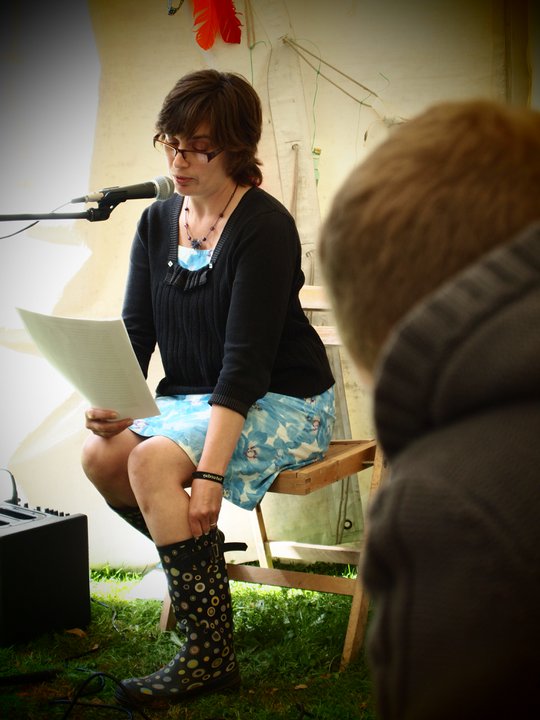
The profwriting peeps are planning to present a variety of work, giving all the readers a five to ten minute slot each. They have picked a tongue-in-cheek circus theme, billing our show as the top attraction. I was asked if I could think of a few lighthearted and funny taglines about my piece to add to the poster. I'll be reading alongside The Man Who Hates Google and The UK's Worst Stand Up. It's always a nervewracking experience, reading (this is me doing it last year, fingering my wellies for comfort). But, well, my book is about breast cancer surgery, and to think of something lighthearted or funny and circusy to sell my work was at first blush a bit of a challenge.
It's not that there is nothing lighthearted in my book; there is a lot of humour because, let's face it, no-one wants to get depressed for the fun of it. I just wasn't sure how to present my work in a circus context. But the book is about Mermaids and Monsters after all, and when my sister said "hey, what about being the freak show?" that was it. An idea popped into my head. So, festival lovers, Roll up! Roll up! Come one! Come all! Visit Port Eliot and prepare to be amazed. Come and meet a Real Live Mermaid! She Speaks! She Laughs! Yes, you heard it here first, folks! The profwriting show is going to be the greatest show on earth!


Thursday, 21 June 2012

The Diving-Bell & the Butterfly

Like most writers, I've recently experienced the classic writer's block. After I got my MA results in March, the momentum petered out. It's not that the results were bad — quite the opposite; it was the enormity of the responsibility to write well that made me feel afraid. One of the most humbling comments I've ever received about my work came from my MA examiner. She said: "For me, the way in which you relay your personal story of breast cancer is as powerful and moving as the likes of Jean Dominique Bauby's The Diving Bell and The Butterfly." The comment almost made me splutter out my marmite on toast and my bangers and mash from the night before. 

I had never read the book, but I have it on my bookshelf. I knew only that it was a powerful and well-written story, and that I needed to own it and read it one day. I remember my friend Emily reading it years ago and it was because she loved it so much that, when I saw it sitting in a random Help for Heroes fundraiser in my newsagents, I had to buy it. Yesterday I finally picked it up to try and unpick what the examiner meant. It was an especially poignant decision to start reading it now. Not so much because of that comment. Because one of the mums at my daughters' school has just had a stroke. She is in her mid-thirties.

Jean-Dominique Bauby survived a devastating stroke but spent the remainder of his life in hospital with locked-in syndrome. Before the stroke, he had been the editor of French Elle. After the stroke, he was paralysed, with the exception that he could swivel his head ninety degrees and blink his left eyelid. He used his eyelid to dictate his book one letter at a time: Claude Mendibil, a specialist nurse, would point to letters on a screen and Bauby would blink once for yes, twice for no. Bauby describes the deadweight of his condition with little self-pity, and he shows how his extraordinary mind takes flight like a butterfly and provides him with respite. And sometimes, even, joy.

My favourite chapter so far is about the Empress Eugenie, the hospital's patroness. In his mind, he befriends her, follows her, is even caressed by her: "I followed her hat with its yellow ribbons, her silk parasol, and the scent of her passage, imbued with the eau de Cologne of the court perfumer...She ran her fingers through my hair and said gently, 'There there, my child, you must be very patient,' in a Spanish accent very like the neurologist's." I love how he mingles his fantasy with reality: the voice of his doctor invades his flights of fancy and brings him back to the unequivocal truth. 

He catches sight of himself in the middle of a reverie with Eugenie one day: "Reflected in the glass I saw the head of a man who seemed to have emerged from a vat of formaldehyde. His mouth was twisted, his nose damaged, his hair tousled, his gaze full of fear." Instead of weeping inside, the moment is euphoric: "Not only was I exiled, paralysed, mute, half deaf, deprived of all pleasures and reduced to a jellyfish existence, but I was also horrible to behold. There comes a time when the heaping-up of calamities brings an uncontrollable nervous laughter - when, after a final blow from fate, we decide to treat it all as a joke. My jovial cackling at first disconcerted Eugenie, until she herself was infected by mirth. We laughed until we cried."

It is the laughter that is inspiring, this honest humour. This is what I need to hold on to in my writing. What on earth am I afraid of when I look at the blank page, the white screen, the dark cave of memory? How ridiculous to worry about what to write when the extraordinary Bauby managed to write a beautiful book by blinking an eye; when a mother of two young boys is learning to walk and talk again; when the heroes we fundraise for have terrible injuries to live with and struggle to cope with the aftermath of bloody conflict. Writer's block just seems stupid. I will keep The Diving-Bell and the Butterfly on my desk and remember Bauby when I'm stuck in the quagmire of my own woes. I will conjure up my own butterflies and take refuge in the imagination. Honestly, what a book! I urge you to read it.


Monday, 11 June 2012

How to find the juicy red wort

A quick note to tell you that I searched online for images of St. John's wort, or hypericum perforatum, so that I can recognise the plant in the woods. Most of the pictures I found showed bright yellow flowers, not red. I wondered where the "juicy red" reference in the fifteenth-century poem (see post below) came from. Another quick google, and it appears St. John's wort flowers have red buds and seed-heads. When crushed, the flowers leave blood-red "juice" behind. Just in case you want to make a magic necklace of your own, like I do, to rub all over your lintel for luck.

St. John's wort: works like a charm?

Slightly weird, but nice: my doctor just congratulated me for deciding to wean myself off anti-depressants in favour of an experiment with St. John's wort. I don't disagree that I need a little help to stay on an even keel; I just would rather it was herbal than chemical, natural rather than man-made. It's the fear of carcinogenesis, that I might be creating or feeding cancer, that has driven the decision. Being diagnosed with early breast cancer has made me think about everything I ingest, put on my skin and use around the house. Quite honestly, it can drive you nuts. I try and be balanced about it. I've never had a problem with taking my prozac because I believe it saved my life: when my daughter died in 2001, I really didn't think I'd be able to keep going. I'm in a good place now though, and so I'm going to give the traditional remedy a try. I love the history and the magic associated with St. John's Wort; that in itself is enough to buoy the mood. I found this poem about St. John's wort online: it apparently comes from a manuscript dating from 1400.

St. John’s wort doth charm all witches away
If gathered at midnight on the saint’s holy day
Any devils and witches have no power to harm
Those that gather the plant for a charm:

Rub the lintels and post with that red juicy flower
No thunder nor tempest will then have the power
To hurt or hinder your houses: and bind
Round your neck a charm of similar kind. 


I don't talk about depression much because it is still so hard to explain and I've got enough on my hands dealing with breast cancer taboos. But I feel I am doing an injustice to the condition by keeping my own depression quiet. Lately I've been called "inspiring" because of the work I've been doing to understand breast cancer surgery, but when it comes down to it, all that research, writing and talking about it is simply about helping me cope. I need to keep the monstrous "black dog" of depression at bay, and I strive to thwart the thunder and the tempests that occasionally roll in. I don't know if that's inspiring so much as surviving. Having read that poem, and knowing that the herb is rife around the British Isles, I might have to put on a cape, pick up my basket and go find some of those juicy red flowers. The time is right; 24th June is the holy day in the poem - it refers to St. John the Baptist's birthday. I think I'm going to make myself a St. John's wort necklace and rub it all over the lintel. 
(Afterthought: This is a picture I took at the Old Operating Theatre and Herb Garret in London Bridge, where I'm pretty sure the ancient apothecaries would have doled out St. John's wort, among other things, to the patients at St. Thomas. This is actually a fascinating display about the story of aspirin, the chief component of which is derived from plants like willow, myrtle and meadowsweet.)

Thursday, 7 June 2012

The Cut and the Cure: the movie!

The Cut and the Cure is now on YouTube! It's a fifteen-minute documentary about my research into breast cancer surgery by James Williams, a final-year student studying film production at Bournemouth University. James came to me a while back, wanting to make a film about breast cancer because it's close to his heart: his family has experienced it first-hand. I've become very fond of James. He's sensitive, intelligent, funny and good-hearted. It's pretty unusual for someone so young to tackle such a difficult subject, but James is not an average student. He lost his father, suddenly, within days of our filming. He knows what loss looks and feels like.

There are two things about the film I have been chewing over. I've been struggling with the placement of graphic surgical imagery so close to the front of the film. I worry that this imagery will have people switching off and missing a central message, which is that viewing surgery as art, as something strangely beautiful, helped me come to terms with going through it. I must accept, however, that this is James's film, not mine. I can use my writing to make surgery accessible; I can imagine the different responses and play with my words accordingly, coaxing people in. When I write, I'm in control. But this is James's film, and I have to relinquish control. I've been holding on to this film, not sure how to share it. Now, I think, I can let it go.

The other thing I want to share is this. A friend and fellow DCIS patient pointed out to me that the way the film is edited makes a case for reconstruction being the "only" way you can feel whole after mastectomy. I don't feel this way at all. I don't wish to strong-arm anybody into having reconstruction. It was right for me; for others, it isn't. Having the choice is what matters. I know that many of the women at the Mermaid Centre who had mastectomies ten, twenty years ago didn't feel the need for reconstruction — and still don't. They have found their own ways to live with their surgeries. I love the story my old friend in upstate New York told me when I first got diagnosed: "Years ago, my grandma made herself a prosthesis after her surgery. She used it as a pin cushion. She used to stick needles and pins in the front of her dress without thinking while she was sewing. It was kind of a shock when she answered the front door..."

So here it is: James's film, The Cut and the Cure. You may or may not find surgery beautiful, but here's to looking something difficult straight in the eye.


Saturday, 26 May 2012

"I've got balance!"

What beautiful weather we've been having this week! I went to Castle Beach yesterday with my children after school and we scoffed strawberries so fast there was no time for the sand to ruin them. Lola and I went for a walk across the rockpools while Daisy clambered further up the beach with her friends. After a few minutes pointing out the red enemies (or anemones, as you wish), Lola stretched her arms out like a gymnast. "Look mum," she said, "I've got balance and I'm not going to fall over. Watch!" She hopped over the green and black seaweed-covered rocks, stopping every now and then to repeat "look at my balance!"

Though I was partly watching through my hands, hating the idea of her falling, I realised I was following her with no fear for myself at all. It was quite a contrast from the way I'd felt about those rocks two years ago, when I was recovering from my mastectomy and reconstruction. We'd gone rockpooling, and it was my husband who followed the children skipping over the rocks. I was so petrified that I stood well back on the firm sand and watched, wringing my hands. I was afraid I would deepen the slow-healing wound on my back and ravage the webbed, puckered scar in the front.

Everything I did (or didn't do) revolved around fear at that time. I couldn't bring myself to step among the rock pools, and neither could I pick up my children, carry the shopping, or bend over the bath and wash my own hair. I couldn't trust in my balance at all. I'd spent months dealing with surgical wounds and scars that wouldn't bloody heal. I was petrified that my body would split open again if I so much as looked at a rock. Now, I realise, I've reached a point where I've healed, my body is whole again, and I'm only as frail as anybody else out on the rocks. There is no extreme wound to pinpoint or analyse or worry about. If I slip, so what? Like Lola says. I've got balance, and I'm not going to fall over. So there.

Wednesday, 16 May 2012

Embarrassing Bodies: "tits out for the nation"

Last night, Channel 4 screened the first episode of their new series, Embarrassing Bodies: Live from the Clinic. A few hours beforehand, a group of women from Cornwall, Mermaid Centre patients past and present, had been tweeting about their journey to Birmingham, where they were going to take part in the show: "we're off to get our tits out for the nation!", "on minibus drinking champagne", "in the green room - no turning back now!" The programme began, and after a brief interlude involving hernias, bums and penises on Skype — the programme invited viewers to call in with their health problems — suddenly there they were. The Mermaids got their breasts out for the nation to show how to look for signs of breast cancer. Viewers at home were invited to follow along, and several were on Skype, interacting with the studio as they looked for unusual lumps, bumps, puckering and creases.

The Mermaids have all been part of a calendar project to raise awareness and funds for a Cornish charity, Made for Life, which supports women with breast cancer, and were quite used to being photographed. But it takes a lot of guts to get your kit off on television in front of millions of strangers. Many of them had already been through surgery, radiotherapy or chemotherapy; one Mermaid was still in the middle of her chemo. They paid tribute to our friend Malina, who died at only 32 in March; her calendar image flashed up on screen: she's enveloping her three-year old son with her whole body, and even in black and white she looks impossibly radiant. 

Back in the studio, the Mermaids' scars were apparent: I could see the bilateral mastectomy with soaring, arc-shaped scars; origami nipples, cleverly constructed out of skin from the back; perfectly colour-matched areola tattoos. Despite the evidence of all they've been through and all that they've seen, they still have hope. All of us felt very proud of our friends who stood up for something they believe in: they did it because if they manage to get just one person to find a lump early, they may well save a life.


Monday, 14 May 2012

The Voice

I'm not going to be talking about Jessie J, Tom Jones or swivelling chairs in this post (there might be a picture though). I've just started to record the voiceover script for the documentary about me and my book on breast cancer surgery, Mermaids and Monsters.

Filming and voice-recording are so different from writing about one's experience. When I write, it's just me having a conversation with myself and I'm very comfortable with that. I don't mind sharing the fruits of that conversation with all the world, on this blog or in my book. I'll tell you anything. But speaking those inner thoughts out loud and talking into the microphone raises the stakes substantially. So does the idea of putting this film on YouTube. It's not nearly as private a process, and as I listen to myself I cringe. South London sloppiness! I'm the female Jonathan Woss! There can't be many people who like the sound of their own voice. It also feels weird because I'm reading the director James's words, and even though his voiceover script is based on things I've said or written, the words don't feel like they belong to me.

Doing the voiceover doesn't come easy, and as I play the recording of part one back I can think of all sorts of changes I would like to make. But that's James's job, so I dutifully read his script the way he wants it, and then I read the script my way so I don't feel like I'm being told what to say. That feels better. I relax even further when I remember how multi-dimensional the film is and how many other voices are involved. Historians, archivists, my surgeon, the breast care nurse, other patients past and present are all an integral part of the final cut. I feel a surge of relief and confidence, and I swing around on my chair, Jessie J style in my leopard print dressing gown, ready to record part two.


Jessie J. 
My dressing gown.

Monday, 30 April 2012

The Final Chapter

I wrote the final chapter of my book today. In my head, at least. I went to the hospital in Hayle to have my reconstruction finished with a tattoo, and it brought a satisfying feeling of closure. It was also poignant, because the last time I went to Hayle it was to say goodbye to my friend Malina, a fellow breast cancer patient. She had been in St. Julia's Hospice, which is directly opposite the hospital entrance. Malina died in March; she was only 32. As I walked past St. Julia's and into the hospital, Malina was by my side. It was hard to be there with my luck, knowing how cruel hers had been.

I waited for Sarah, one of the Mermaid's breast care nurses, to collect me from the waiting room. I watched as familiar faces came and went along the corridor: there was the jolly porter who'd wheeled me down to the operating theatre for surgery, still chipper and smiling at everyone. And there was the other porter I knew, the one who DJs and loves Shakin' Stevens. I saw an advert for one of his discos in a pub window yesterday. Through the double doors behind me were the sterile blue operating theatres, where I've been both patient and observer. So many stories have been played out behind those doors. The stairwell echoed as I followed Sarah to the clinic rooms.

Sarah laughed when I told her how glad I was to be there. I took her a copy of the blog post I wrote about the Blush and the Bounty and gave her a bottle of rosé (I had looked for blush, but no luck). We lined up the bottles of tattoo ink and I took photos of her holding the wine. I undid my gown and Sarah began tattooing, noting with wonder the areas of sensitivity in my new breast. 

When I was inked and dressed, she gave me my discharge form. I walked out of the clinic and into the rain and said goodbye once more to Malina. I remembered a line from a book about Buddhism by Sylvia Boorstein. "We don't get a choice about what hand we are dealt in this life. The only choice we have is our attitude about the cards we hold and the finesse with which we play our hand." Malina managed to play hers so well with so little time, I thought; I am going to try and do the same. And then I walked to the car.